
Use cases
Deliver a feature through the full SDLC
Use Full Lane to guide a substantial feature from requirements through HLD, LLD, implementation, code review, and QA with reviewable artifacts at each stage.
Start with the outcome, then guide the details
Use Full Lane when a feature needs meaningful requirements, architecture, or contract decisions before coding. One durable session carries the work between Product, Architect, Lead, Implement, Code Review, and Verify, with deployment planning and learning work when applicable.
Set the desired depth through the request and feedback on the artifacts. Inspect the current revision at the decision points the workflow presents. Configurable stage-review settings do not remove material or safety decisions.
Start a Full Lane request
Connect GitHub or Bitbucket and an agent provider in Integrations. Select the repositories for your product and let Factory setup prepare them automatically. Review and merge any required setup PRs in their respective repositories. Configure models in Agents and compute in Settings.
- Open Sessions and select New.
- Select Build and add repository hints.
- Start the message with
/full-lane. - Describe the outcome, constraints, acceptance criteria, and design decisions you want to review.
- Submit, then follow the stage progress and artifacts in the same session.
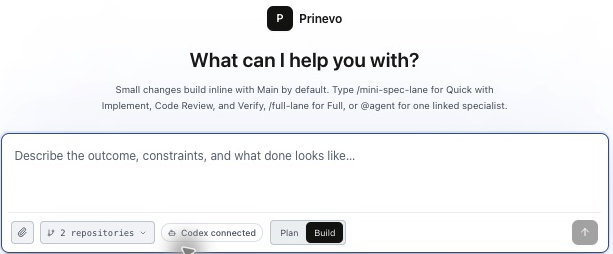
/full-lane Build owner-controlled workspace invitations.
Owners can invite teammates and choose the appropriate role.
Members can view settings but cannot change workspace access.
Record an audit event for each access change.
Preserve existing member access and API compatibility.
Review requirements, HLD, and LLD/task plan before implementation
at the applicable decision points. Include API, UI, failure-path,
and regression verification in the plan.
Return reviewable PRs, review findings, and criterion-level QA evidence.
Control PRD, HLD, and LLD detail
| Artifact | What it answers | Example feedback |
|---|---|---|
| Product requirements document (PRD) | Who needs the feature, behavior, scope, acceptance criteria, and edge cases. | “Specify what happens when an already-invited email is submitted again.” |
| High-level design (HLD) | System boundaries, ownership, contracts, data flow, compatibility, and rollout risk. | “Explain where server authorization lives and how current members retain access.” |
| Low-level design (LLD) and task plan | Component responsibilities, interfaces, validation, state and error paths, tasks, and tests. | “Map each acceptance criterion to implementation tasks and the checks that prove it.” |
Ask for a correction in the current decision or session when an artifact omits important behavior. Revisit the affected design and approvals if a later change alters the accepted scope or contracts.
Read worked PRD, HLD, and LLD excerpts. Those excerpts illustrate the artifact structure; they are not claimed as captured run outputs.
Follow implementation and independent review
Open Work to inspect stage owners and progress, and Artifacts for available outputs. Implementation may produce changes in several repositories; inspect every resulting PR and its dependencies.
Code Review checks the implementation against the accepted behavior and relevant risk dimensions. Actionable findings return for correction. Confirm the reviewed revision is the one that proceeds to verification.
See review dimensions · Understand artifact and evidence links.
Review verification and the delivery state
Open Verification to compare acceptance criteria with executed scenarios and published proof. Inspect the execution report, checks, and available screenshots or video. Read blockers and coverage gaps alongside pass counts.

- The final scope matches the accepted requirements and revisions.
- Review findings are resolved and required checks pass on the current code.
- Evidence is available and relevant to the acceptance criteria.
- When needed, deployment guidance covers sequencing, migrations, monitoring, and rollback.
- The team knows whether work ends at reviewed PRs, a release-ready plan, or an approved deployment.
Full Lane automates the delivery workflow; merge and deployment follow the configured approvals. Check the actual delivery state rather than treating a completed design or QA artifact as proof of production release.
Complete Full Lane guide · QA and verification · Handle failures and feedback