
Use cases
Review architecture before implementation
Ask the Architect specialist to examine a proposed design, identify boundary and compatibility risks, and return a focused architecture artifact before you commit to code.
Resolve a design question before it becomes rework
Use a focused architecture review when you already have a proposal or a specific decision to make. Examples include introducing a service, changing an API boundary, assigning data ownership, or planning a migration. Supply the current design, affected repositories, constraints, and the alternatives you are considering.
A single Architect task gives you a bounded recommendation. Choose Full Lane when you want requirements, design, implementation, review, and QA coordinated as one delivery workflow.
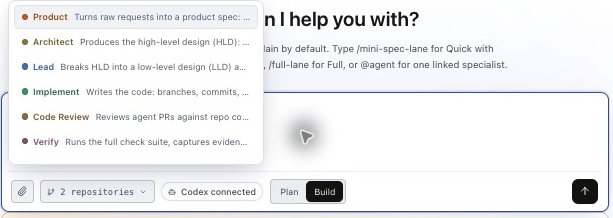
Choose Architect in the session composer
Connect GitHub or Bitbucket and an agent provider in Integrations. Select the repositories for your product and let Factory setup prepare them automatically. Review and merge any required setup PRs in their respective repositories. Configure models in Agents and compute in Settings.
- Open a new session and select Build.
- Type
@and choose Architect. - Attach the proposed design and relevant repository hints.
- Name the decision, constraints, and output you want. Submit the focused task.
@Architect review this proposal to separate notifications from billing.
Inspect the affected repositories and the attached design.
Compare the proposed boundary with the current system.
Address data ownership, API/event contracts, retries, compatibility,
and rollout risks. Return a recommendation and unresolved decisions.
Keep this task to design review; implementation requires a separate request.
Assess the recommendation
- The proposal reflects the current code and stated requirements.
- Ownership, interfaces, and data flow are explicit.
- Failure modes, compatibility, and rollout implications are addressed.
- Alternatives and tradeoffs are explained with relevant evidence.
- Open questions have an owner and a next action.
Give feedback in the same session if the design misses an important constraint. Use the accepted result as context for the next planning or implementation task.